Disclaimer: This content is unclassified and has been shared within Combined Space Operations CSpO allies (US, UK, Canada, Australia, and New Zealand). It includes sensitive military context with high-risk implications for national space security and is intended for restricted circulation. Please refrain from further distribution.
Phase 2: Individual Data Pages
Improved individual data pages across Launches, Re-entries, Conjunctions, Breakups, and Mega Constellations, each made more tactical, more readable, and more useful in real operational conditions.

Multiple Disovery Sessions
Feature and data improvements on individual pages are the next prioritization for Space C.O.P including:
Launches
Re-entries
Breakups
Conjunctions
Items of Interest
Based on the discussions after the Summary Dashboard, Space C.O.P now moved on to focus on the current individual data page to understand how we could make them more tactical and surface the highest priority information for operators. It is crucial that interesting and cool data is available and integrated but doesn’t sacrifice at-a-glance readability for operators.

Launches Disovery
A discovery session is ran with the cilent internal team to gather more insights about the needs for Launches Data

Re-entry Discovery
Similar to the approach of Launches Page, a discovery session is ran with the cilent internal team to gather more insights about the needs for Re-entry Data since there is a limitation of knowledge about this.
Mid-fi Launches Page
A quick mid-fi prototype created as followed: dark-mode, consistent with the Summary Dashboard, built for speed to feedback rather than finality.


Mid-fi Re-entry Page
Similar to the approach of Launches Wireframe, a quick mid-fi of Re-entry is also created with the updated pieces of data layout using the dark mode components similar to the Summary Page and Launches Page UI design. The goal of this is to save time, create a quick ideation for a combined usability testing with other pages, and get feedback before implementation without losing any current functionality.

Combined Usability Testing
Over two weeks, moderated usability testing sessions were run with SDA operators on both Launches and Re-entry. Open feedback sessions ran alongside — giving analysts space to raise issues that structured scenarios wouldn't always catch.


Affinity Mapping

Key Learnings
Failure and partial failure statuses need to stand out visually
T- and T+ countdowns need to be clearly distinct; T- under 10 minutes needs its own treatment
Color and icon differentiation genuinely helped them absorb information faster, not decoration, utility
Date-based navigation fit naturally into how they worked
The first thing operators looked for on Re-entry was the next 12 hours
A D-1 to D+3 date range felt right
Moving manual entry to an expanded view didn't disrupt workflow at all
Deliverables
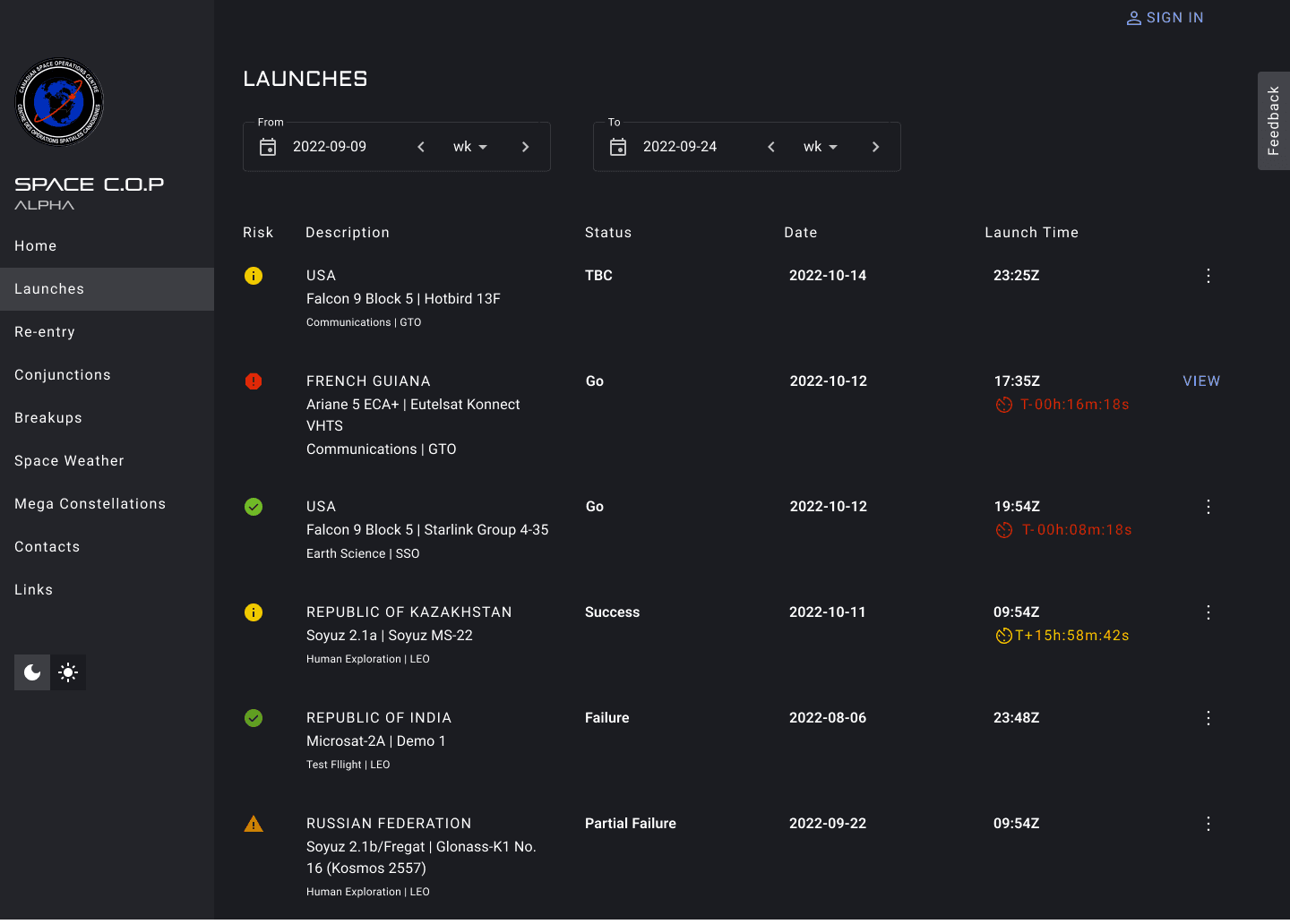

Luanches Page
Main view, pinning, "Concern to Canada" edit modal, expanded history view, before/after comparison.

Concern to Canads

Expanded View
Re-entry Page
Main view, expanded view, hazardous materials dialogue, ground trace visualization, before/after comparison.

Main

Expanded View

Hazardous Materials Dialogue

Ground Trace Visualization
Conjunctions Page
Main view, visualization, details view, before/after comparison.

Main

Conjunction Details

Conjunction Visualization
Breakups Page
Main view, expanded view with Concern to Canada section, expanded view with breakups dialogue, visualization, before/after comparison.
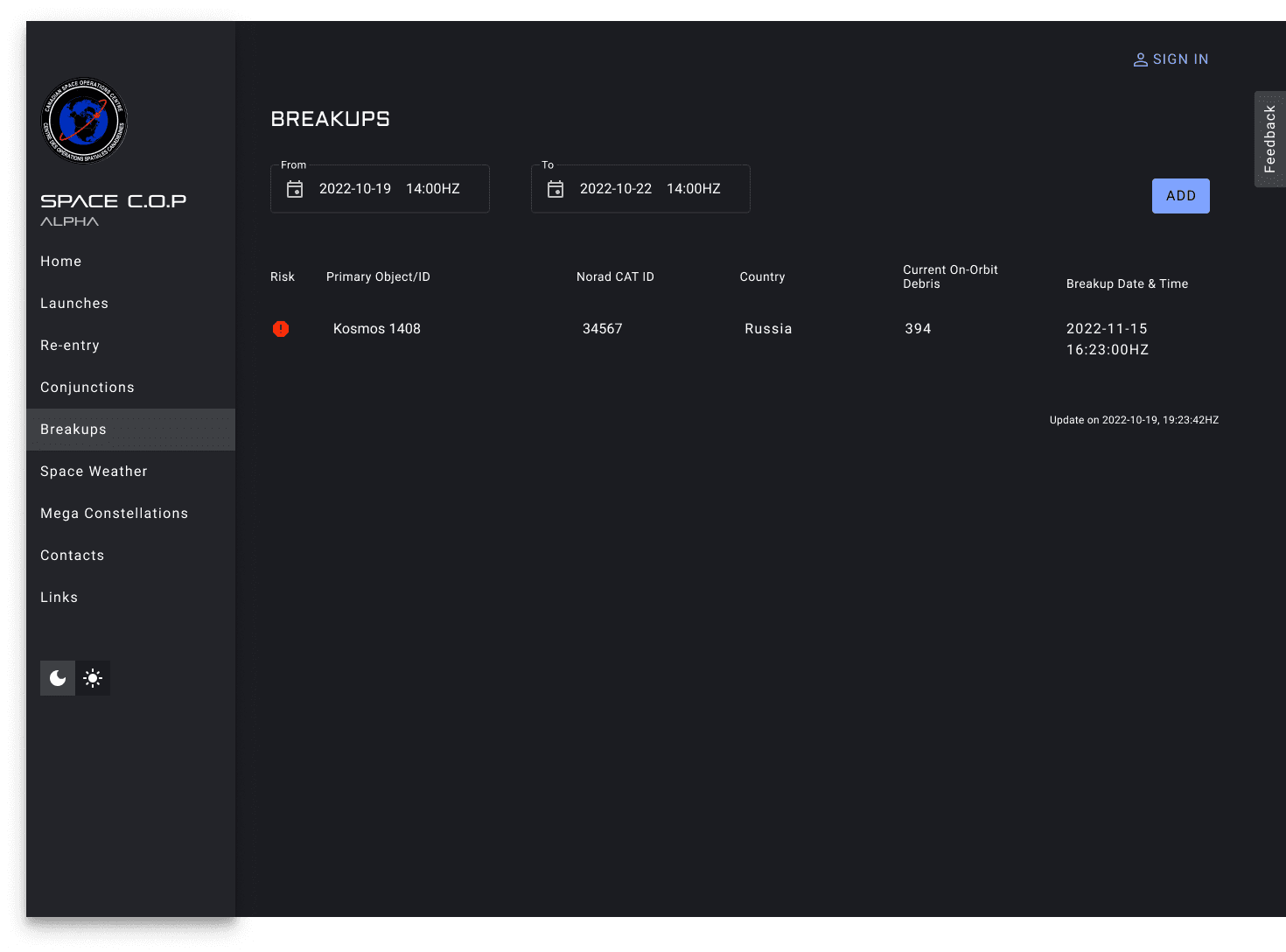
Main

Breakups Dialogue

Breakup Expanded View

Breakup Visualization
Mega Constellations Page
Main view

What is next?
Phase 2 sharpened the individual data pages. But launches, re-entries, and conjunctions are all events with timestamps. Geostationary Orbit (GEO) is something else entirely. It's a live, continuous picture of where satellites are right now, where they're headed, and what's creeping too close to something that matters. Phase 3 was about building that picture for the first time inside Space C.O.P, giving analysts a real-time view of the GEO belt where Canadian assets, adversary satellites, and debris all share the same space.
